
The search engine market is currently dominated by a handful of companies, or even a single one. However, many alternatives exist. The importance of privacy on the Internet has become crucial in recent years, which has favoured the emergence of numerous alternative search engines. At the same time, advances in artificial intelligence are also transforming the world of search engines, with ever deeper AI integration.
This article offers an overview of the different search engines available, highlighting their specific features, their approach to confidentiality, as well as their integration of artificial intelligence.

Google has become the search engine par excellence. It now represents almost 90% of the search engine market share. It is moreover almost certain that you use Google every day. Its popularity is explained by its ease of use, its features and its search ranking algorithm which was extremely ahead of its competitors, especially at the very beginning of the Internet. Nevertheless, its near-monopoly can also be explained by actions that may have been considered anti-competitive, such as paying Internet browser or phone developers (Apple for example) to set Google as the default search tool.
The website ranking algorithm is one of the reasons for Google’s success. For each search it ranks web pages in such a way as to give the results it deems most relevant first. This allowed Google to provide more relevant answers than its competitors, especially in the early days of the Internet. This algorithm is of course kept secret, not only so as not to reveal it to competitors, but also so that different websites cannot over-optimise their content to appear higher in the list, even if certain characteristics on which this algorithm is based are made public. For websites it is essential to appear on the first page of Google searches. Indeed, the chances that your site will be visited when it is on the second or third pages of Google searches are quite low – ask yourself when you last went to look at the results of one of your searches on the second or third page of Google? Google has well understood this and it is possible to pay, thanks to Google Ads, to appear at the very top of certain searches. Depending on the searches the price can be very high.

However, all these advantages come in exchange for your data. Since the use of the tool itself is free, Google had to find a way to make a profit – after all it remains a company. It is through advertising and the collection of your personal data that Google makes money, which raises the question of confidentiality and respect for privacy. All of a user’s actions – clicks, searches, websites visited, etc. – are recorded by Google in order to offer targeted advertising. Google’s “secondary” services such as Maps or YouTube also take part in this data collection. Google shares, or rather sells, the data it collects with advertising agencies but also with statistics agencies, etc. Google is also obliged, if requested, to share any information in its possession with American intelligence services.
Google has its own AI which they are quick to add to their search tool, Gemini. Its launch was chaotic. The answers given were false or simply absurd. Although many errors have been corrected, Gemini remains a fairly “new” tool and its reliability is quite doubtful, especially compared to its competitors and to Google’s “classic” searches. It does however seem to excel as a classic chatbot. It is also implemented in Docs and Gmail. The basic functions are free but to access the advanced functions of this AI, you will have to pay 17 CHF per month.
Bing

Bing is Microsoft’s web search tool. Although far less used than Google, it has the second largest market share. Very similar to Google, it also collects its users’ personal data. This collection nevertheless seems less extensive than Google’s. Microsoft presents Bing as being more focused on respect for privacy than Google, but the veracity of this information is complicated to verify.

Bing also offers an AI integrated into its search engine and into Microsoft’s Internet browser – Edge, Microsoft Copilot. One of the first AI tools integrated into a browser, Copilot is based on the architecture of GPT-4 and more recently, since late 2024, GPT-4o mini from OpenAI. The web information that ChatGPT obtains comes from Bing, which explains why some of the links provided are obsolete. Although still imprecise on certain answers, it gives the source of its searches, which makes it easy to verify the origin of the information. Searches are made on the Internet. An image or a file can be added to the user’s query if necessary, to give context or for another reason. Copilot for its part is free in its basic version. The paid version for its part allows Copilot to be integrated into Microsoft’s other products, such as Word, Excel, Outlook, as well as directly into Windows in order to simplify and optimise work. This allows it to give answers to questions that touch on information on your computer; it can for example summarise a PDF file you might have or help you draft a report. The pro subscription also gives access to more advanced versions of the AI, and therefore more precise and correct answers. The pro version is available for 21 CHF per month per user.
DuckDuckGo

DuckDuckGo is a search engine focused on respect for privacy. It is just as effective, gives answers to queries that are just as relevant and includes all the “classic” functions of search engines. Respect for privacy is an important element of DuckDuckGo. It does not save a search history of its own and keeps no information on its users’ actions. There is no data collection on DuckDuckGo’s part and searches are not linked in any way to your personal information, adding a high level of anonymity. Although it offers advertising – it does have to finance itself somehow – these ads are not personalised since no personal data is collected. The quality of searches is not affected by this high degree of respect for privacy.
DuckDuckGo also has a dedicated web browser that emphasises respect for privacy. Numerous features that go in this direction are included: private searches by default, automatic blocking of advertising trackers, automatic blocking of cookie pop-ups, automatic blocking of third-party trackers. The DuckDuckGo web browser also offers the possibility of talking with several AI models.
NEVERTHELESS, DuckDuckGo admitted that its tracker blocker blocked all trackers, EXCEPT those of Microsoft. Indeed, they have an agreement with Microsoft so that the latter provides Bing as the search engine that sits behind DuckDuckGo.
In other words, DuckDuckGo routes its queries through Bing to obtain better results thanks to their more powerful algorithm. So yes, DuckDuckGo blocks cookies and third-party trackers, except those of Microsoft… After this was revealed the company with the duck logo promised to make efforts and to limit the number of Microsoft trackers authorised to function.
DuckDuckGo also includes an AI assistant that gives brief answers to your queries, while providing the source of its information, as well as an AI chatbot called Duck.ai. The latter is available based on several AI models: Claude 3 Haiku from Anthropic, Llama 3.3 70B from Meta, Mistral Small 3 24B from Mistral and GPT-4o mini from OpenAI. With a view to respecting privacy, the queries made are anonymised and no training is done on them.
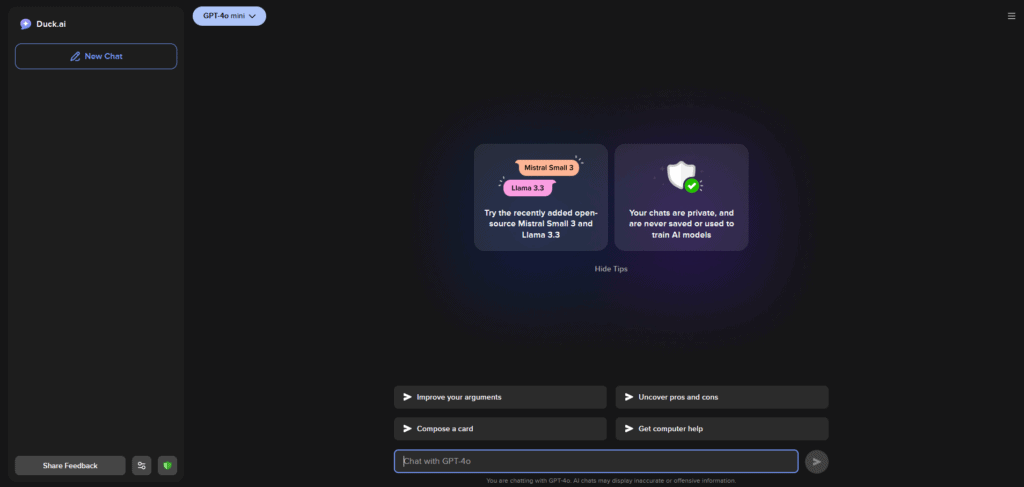
The Duck.ai interface
Qwant

Qwant is a French search engine based in Europe, guaranteeing that your queries are only processed on the continent. It is similar to DuckDuckGo, although smaller, in its privacy policy. Qwant does not save personal data and therefore does not sell it, does not track its users, and searches are not personalised. There is also an AI similar to those already mentioned, but unlike DuckDuckGo, you have to log in to be able to use it.
Searx
SearXNG is an open-source search tool that also focuses on privacy. It does not store information on its users, does not give information on its users to third parties and the code is entirely open. Completely open source, it can also be self-hosted on your own server and integrated into your projects. It is a “metasearch engine”, meaning that the searches made on it are sent, confidentially and without sharing user information, to other search engines, and their answers are sorted and presented to the user through SearX. This allows access to the answers of several search engines in a single place. Being an open-source project there is no “official” instance of SearX. The search engine can be accessed via several links, hosted by members of the community. There are also negative points. The main one being that SearX’s algorithm for classifying the relevance of results is not at the same level as that of its major competitors; there is also the fact that, from experience, different instances of SearX can give different results, or ordered differently for the same query. It can also struggle with longer queries.
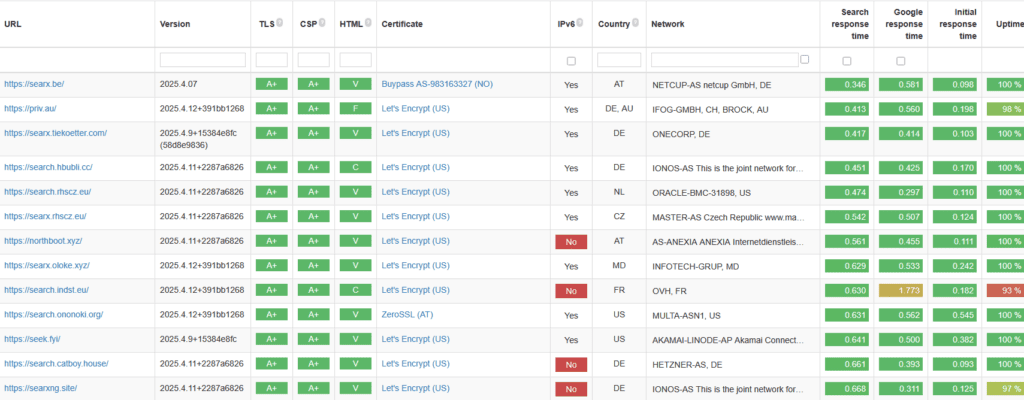
Some of the public instances of Searx; the complete list can be found at https://searx.space/
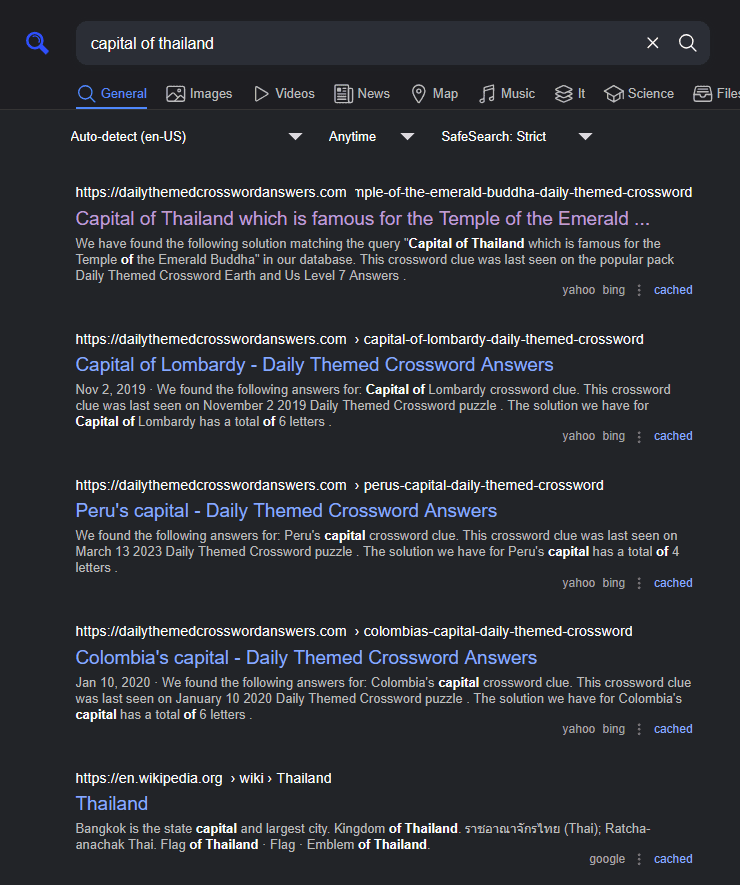
Answers from a SearX instance for “Capital of Thailand”; the first 4 answers come from a crossword site

Answers from another SearX instance for the same query
Startpage

Startpage is a Dutch metasearch engine. It neither saves nor collects data from its users nor a search history. Its users’ IP address is masked. Having no data on its users, Startpage does not offer personalised searches or personalised advertising. Startpage goes through two levels of servers: the first removes the IP addresses and personal information of its users, the second level sends the queries to the various secondary search engines such as Bing and Google. Their answers are then displayed to the user, all without Bing and Google having access to your data.
Startpage also offers an “Anonymous View” feature. The features of Anonymous View are similar to those of a VPN, except that here Startpage uses a proxy. In other words, the websites visited will not see that it is “you” visiting them but will think it is Startpage. Your IP address and your “digital fingerprint” (which device you use, which plugins are installed, your location, your system language, etc. – everything that could be used to identify you) are masked and hidden from the websites you visit.

Using Startpage is fairly simple and practical. The answers given are relevant. Comparing with DuckDuckGo and SearX, Startpage seems the best option – it is simpler to use, with more relevant answers than SearX, and the level of confidentiality is far superior to that of DuckDuckGo.
Conclusion
In conclusion, the search engine landscape is diverse and constantly evolving. Although Google largely dominates the market thanks to its algorithm, its longevity and its numerous features, alternatives exist. Bing, DuckDuckGo and Qwant offer interesting options, notably in terms of respect for privacy and integration of artificial intelligence. DuckDuckGo and Qwant seem particularly interesting alternatives in these respects, and SearX stands out for its self-hosting capability. As for Startpage, it seems to offer a real private and confidential alternative to classic search engines. In the end, the choice of search engine will depend on each user’s priorities in terms of confidentiality and features.